Introduction
The ownership of a residential apartment does not, by itself,confer an unrestricted right to operate the apartment as a short-termaccommodation business.
A short-term letting arrangement may be viewed differently depending on its structure and frequency. A genuine homestay typically involving the owner’s continued residence in the premises and accommodation offered within the owner’s home may fall within a tourism-registration framework. By contrast, repeated turnover of unrelated guests, remote check-in, commercial pricing, professional cleaning, advertising on online platforms and operation of the entire apartment as transient accommodation may be characterised as a commercial short-term rental.
The legal position is not governed by a single nationwide “Airbnblaw”. It usually requires an analysis across several legal and regulatorylayers: State or Union Territory tourism and accommodation rules; thebuilding’s sanctioned use and municipal regulations; apartment,cooperative-housing or society legislation; the registered declaration, deed ofapartment and applicable by-laws; fire, safety, police-verification andlocal-authority requirements; contractual restrictions imposed by thedeveloper, association or society; and applicable tax, licensing anddata-handling obligations.
The practical conclusion is neither that allshort-term rentals are prohibited nor that every apartment owner is free tooperate one. The result depends on the applicable jurisdiction, the precisenature of the use and the governing documents of the building.
The regulatory starting point
The Ministry of Tourism’s guidelines for classification of “Incredible India” Bed & Breakfast and Homestay Establishments are not, by themselves, a universal licence to operate short-term accommodation anywhere in India.
The national guidelines are designed as a classification framework and contemplate conditions including: owner or promoter residence at the establishment; a prescribed maximum number of rooms and beds; minimum standards relating to hygiene, safety and facilities; registration or classification through the relevant process; and compliance with applicable local requirements.
The guidelines have limited operation where a State or Union Territory has its own homestay or bed-and-breakfast scheme. They should therefore be treated as a baseline reference only where applicable, rather thanas a substitute for State, municipal or housing-society approvals.
A business should first determine whether the relevant State or Union Territory has introduced its own homestay policy; bed-and-breakfast scheme; guesthouse or lodging regulations; tourism registration process; police-verification requirements; fire-safety requirements; local operating licence; or restrictions on short-term accommodation in residential premises.
In most cases, the legalanalysis involves at least three interacting layers
Tourism and accommodation regulation
The State or Union Territory may regulate the establishment as ahomestay, bed-and-breakfast accommodation, guesthouse, paying-guest facility,lodging house or another category of commercial accommodation.
The relevant rules may address: who may operate the accommodation; whether the owner must reside at the premises; the number of rooms or beds permitted; registration and inspection; guest records and identity documents; police reporting; fire and health requirements; signage and advertising; renewal and cancellation; and sanctions for unregistered operation.
The applicable category should not be assumed from theplatform used to advertise the property. An Airbnb listing does not determinewhether the premises legally qualify as a homestay.
Apartment, cooperative and society law
A residential apartment may be governed by: an Apartment Ownership act; a State cooperative societies statute; a condominium or apartment declaration; a deed of apartment; the society’s registered bye-laws; association rules and regulations; resolutions of the general body; and contractual covenants agreed with the developer or other owners.
These instruments may regulate: the permitted use of theapartment; commercial activity; paying-guest arrangements; use of common areas;entry and exit of visitors; security and access-control systems; nuisance anddisturbance; subletting and licensing; minimum lease terms; and sanctions forbreaches.
The question is not simply whether the owner owns theapartment. It is whether the use is consistent with the legally bindingframework governing the building and its common facilities.
Municipal and sectoral requirements
Independent requirements may arise under: sanctioned buildingplans; development-control regulations; municipal licensing laws; fire-safetylegislation; health and sanitation rules; local police requirements; taxationand trade-licence regimes; electricity and water-use conditions; and othersector-specific regulations.
A tourism registration, where available, may not curea breach of the sanctioned building use or a prohibition in the registeredbye-laws.
Homestay versus commercial short-term rental
The label used by the owner is not decisive. The factual operationof the premises is likely to matter more.
Relevant indicators may include: the owner or operator continuesto reside at the premises; only part of the home is offered to guests; thenumber of rooms and beds falls within the applicable scheme; the owner remainsinvolved in guest supervision; the arrangement is registered under theapplicable tourism framework; guests use the premises as part of a hostedaccommodation model; and the operation is consistent with the building’spermitted use.
The risk of a commercial-use characterisation increases where: the entire apartment is repeatedly offered to transient guests; there is a high turnover of occupants; the owner does not reside at the premises; access is controlled by smart locks or remote arrangements; the property is advertised continuously on online platforms; the apartment is professionally managed; cleaning and linen services are routinely provided; pricing is calculated by night or short stay; guests have no relationship with the owner; the activity is operated for profit; or the use resembles a hotel, serviced apartment or lodging business.
No single factor is necessarily conclusive. Theassessment is likely to be fact-specific and may differ between jurisdictions.
The significance ofbuilding rules and court decisions
The Gujarat High Court decision in Kamaldeep Singh v. Shivam Satellite Co-operative Housing Society Ltd.[1] illustrates the importance of the building’s governing rules. The Court declined to interfere with an interim injunction restraining the use of a flat for homestay or paying-guest purposes. It observed that resolutions of the general body would bind the member while they remained in force and had not been overturned by a competent forum.
The Court also held that the Ministry of Tourism’s homestayguidelines did not have statutory force and were not binding on the housingsociety.
The case supports several practical propositions: tourismguidelines do not automatically override private or statutory housing rules; asociety may be able to enforce valid restrictions through appropriateproceedings; the enforceability of a resolution depends on the governingstatute, declaration and bye-laws; the owner may challenge the restrictionbefore the appropriate forum; and the mere fact that a property is described asa “homestay” does not resolve the dispute.
The decision should not be presented as a universalprohibition on Airbnb-style accommodation throughout India. It is ajurisdiction-specific decision arising from its own facts, statutory frameworkand procedural posture.
Apartment ownership legislation
The precise position depends on the relevant State legislation andthe documents governing the property.
Under the Uttar Pradesh Apartment (Promotion of Construction,Ownership and Maintenance) Act, 2010, an apartment owner is required to complywith the applicable bye-laws[2] andcovenants in the deed of apartment. The legislation also provides for theformulation of bye-laws by the association of apartment owners. A breach maysupport claims for damages or injunctive relief, depending on the facts and theapplicable provisions.
The Delhi Apartment Ownership Act, 1986 provides a separatestatutory framework for apartment ownership in Delhi[3]. The Actshould be read with the relevant declaration, bye-laws and other applicablelocal requirements.
These statutes should not be treated as interchangeable. Alaw-firm analysis should identify the governing State law rather thangeneralise from Uttar Pradesh or Delhi to all Indian residential developments.
Enforcement and remedies
Subject to its statute, declaration and bye-laws, an associationor society may be able to issue a notice identifying the alleged breach;request information concerning the use and occupants; require production ofapplicable registration or approval; invoke a valid internal penalty mechanism;regulate access to common facilities in accordance with the governingdocuments; refer suspected statutory breaches to the relevant authority; seekdamages where legally available; seek an injunction restraining prohibited use;and commence or defend proceedings before the appropriate forum.
The association should act within the scope of its legal powersand follow the procedure prescribed by the governing documents.
Self-help measures create significant legal risk. Unless clearlyauthorised by statute, contract or valid bye-laws, an association should notforcibly remove occupants; use force to enter the apartment; lock the ownerout; disconnect electricity, water or other essential services; seize personalproperty; threaten or harass guests; publish personal information orallegations; impose penalties without procedural authority; or claim toterminate ownership rights by resolution.
An association does not generally acquire a power of evictionmerely because it objects to the use. Dispossession and eviction ordinarilyrequire a lawful basis and, where necessary, an order of the competentauthority or court.
A prudent enforcement sequence may be: identify the applicablestatute, declaration and bye-laws; document the alleged short-term rentalactivity lawfully; determine whether tourism registration or local licensing isrequired; issue a reasoned notice to the owner; provide a reasonableopportunity to respond; verify whether the alleged restriction is valid andproperly adopted; refer regulatory breaches to the appropriate municipal,tourism, fire or police authority; consider mediation or negotiated compliance;and seek an injunction or other relief where necessary.
The appropriate route will depend on the seriousness of thebreach, the evidence available and the powers conferred by the governingdocuments.
Key risk areas for owners
An owner considering short-term letting should conduct apre-launch review covering the following matters.
The sale deed; deed of apartment; declaration; society orassociation bye-laws; house rules; general-body resolutions; developercovenants; lease or mortgage restrictions; and any rules concerning sublettingor commercial use should be reviewed.
The owner should confirm tourism registration; local trade orestablishment licence; fire-safety approval; police-verification requirements;guest-record obligations; municipal permissions; tax registration andreporting; signage restrictions; and any sector-specific requirements.
Operational controls should include guest identity verification;visitor and occupancy records; emergency contacts; fire and safety procedures;access-control protocols; restrictions on parties and events; noise andnuisance controls; waste-disposal arrangements; insurance review; and a processfor responding to complaints.
Contractual and platform arrangements should be reviewed,including the platform’s host terms; cancellation and liability provisions;indemnities; insurance exclusions; data-processing terms; sub-processorarrangements; guest conduct requirements; dispute-resolution provisions; andplatform suspension or termination rights.
Key risk areas for associations and societies
Associations should avoid adopting a blanket approach withoutreviewing their legal authority.
Before enforcing a restriction, the association should determinewhether the restriction is contained in the registered declaration or bye-laws;whether it was validly adopted; whether the general body had authority to passit; whether the restriction is sufficiently clear; whether it applies to therelevant use; whether it is consistent with the governing statute; whethersimilar breaches have been treated consistently; whether the proposed penaltyis authorised; whether due process has been followed; and whether the proposedremedy is proportionate.
A resolution that is procedurally defective,inconsistent with the governing statute or unsupported by the declaration maybe vulnerable to challenge.
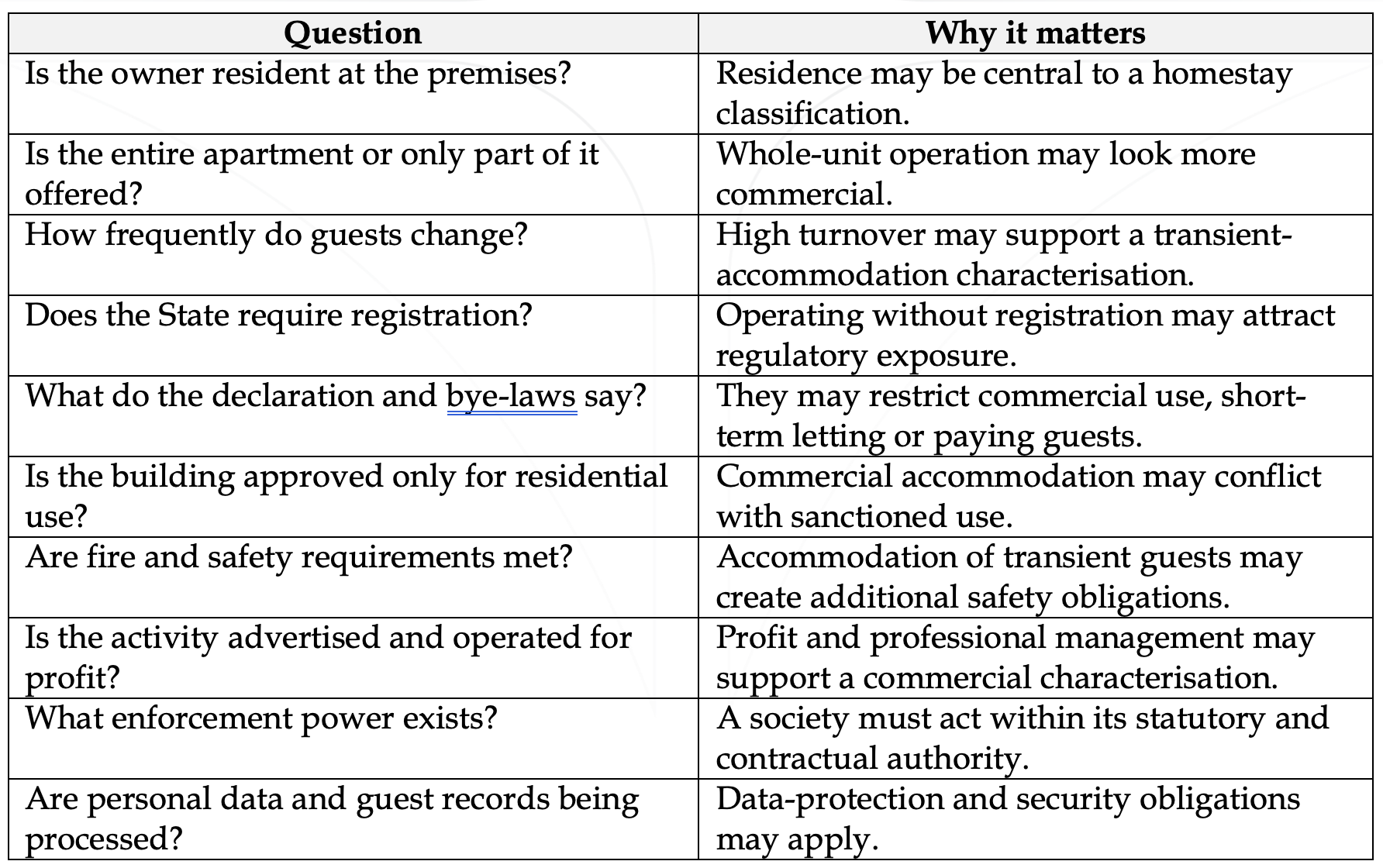
A decision framework
Conclusion
Indian law does not impose a single nationwide rule that eitherpermits or prohibits all Airbnb-style short-term rentals in residentialapartments.
The legal position depends on the interaction between: theapplicable tourism regime; the factual nature of the accommodation; thesanctioned use of the premises; apartment, cooperative or society law; theregistered declaration and bye-laws; municipal, fire and police requirements;and the remedies available to the association or affected parties.
A tourism classification does not necessarily override a validrestriction in the building’s governing documents. Conversely, a society cannotassume that a general objection to short-term guests gives it an unrestrictedpower to dispossess an owner, disconnect utilities or impose unauthorisedpenalties.
For owners, the correct approach is to verify the regulatory andcontractual position before listing the property. For associations, the correctapproach is to identify the legal source of the restriction, follow a fairprocedure, and use statutory or judicial remedies rather than self-help.
The most reliable legal question is not whether the property islisted on Airbnb, but whether the actual use is legally permitted in thatjurisdiction, under that building’s governing documents and subject to theapplicable regulatory conditions.
Notes:
[1] Kamaldeep Singh v. Shivam Satellite Co-op. Hous. Soc'yLtd.,R/Special Civil Application No. 6108 of 2018, 2018:GUJHC:53685, Para. 29 (Guj.H.C. Dec. 13, 2018).
[2] The UttarPradesh Apartment (Promotion of Construction, Ownership and Maintenance) Act,2010,U.P. Act No. 16 of 2010, §§ 6(1), 14.
[3]The DelhiApartment Ownership Act, 1986, Act No. 58 of 1986 (India).
Author’s disclaimer
This article reflects the views and analysis of theauthor based on publicly available information as at 23 September 2026. It isintended for general informational purposes only and does not constitute legal,regulatory, property, tax or other professional advice. The legal position mayvary depending on the State or Union Territory, the governing apartment orsociety documents, the precise nature of the accommodation, the applicablemunicipal and tourism requirements, and subsequent legislative, regulatory orjudicial developments. Readers should obtain independent professional advicebefore relying on this article or taking action.
Prepared by Kunal Sharma, Founder & Managing Partner, with assistance from Nimit Jain, Paralegal. For any queries, please contact us at info@tarakshlaw.com.